
Our approach
The Second Circle as an ecology of the possible
How does a good idea become a movement that truly carries an organisation? The second circle is a living field of resonance and support around a transformation – where the new arises through interplay.
Why now
Transformation rarely fails on the idea, but on the strength to carry it. Left to the core team alone, much is lost:
-

The core team is overloaded and can't keep up on its own.
-

Existing innovation potential and transformation energy stay unused.
-

Resistance builds up.
-

Valuable knowledge in the system lies idle.
-

Acceptance and reach are missing.
What it's about
The more complex a challenge, the less it can be fully planned. What helps is the principle of emergence: in living systems, the new arises above all through the interplay of many actors.
A second circle turns this into an ecology of the possible: a space where signals become visible, diversity comes together, and single impulses grow into shared movement.
Emergence is the arising of new structures and qualities from the interplay of different elements.
Three principles of emergence
-
The Adjacent Possible
The next possible: emergence doesn't arise arbitrarily. Stages of development can be accelerated by density, but not skipped.
-
Superposition
Spaces of possibility: a place where several states are visible and accessible at once, before they collapse into one. Emergence needs spaces of possibility.
-
Ashby's Law
Requisite variety: a system can only handle complexity if it has enough internal variety to respond to the variety of its environment.
These three key concepts describe the conditions for emergence: exploring the next possible, keeping spaces of possibility open, and bringing variety into the system. The point is to prepare the conditions in a social field so that these principles can take effect. And this is exactly where the second circle comes in.
What the second circle is
Around the core team of a transformation, a circle of active co-creators forms: people from different corners of the organisation who help carry it without taking over the steering. It is a field of resonance, learning and support – where it becomes visible where energy arises, which perspectives are missing, and how impulses grow into shared capacity to act.


But aren't these just multipliers?
Classic multipliers …
- are named or trained
- often receive clear messages or materials
- pass content on top-down
- have a defined role
- are mostly one-directional
- distribute content
The second circle, by contrast …
- arises from intrinsic interest
- offers no ready-made messages – these are developed together
- assigns no roles
- builds on what is already there
- is a space for cooperation
- takes shared responsibility and can act on its own
What the second circle needs
-
 Diversity cognitive, professional, hierarchical and experiential variety
 -
 Quantity enough signals for patterns to emerge
 -
 Room to experiment the next possible is felt out, not just discussed
 -
 Redundancy makes the system robust and able to learn
 -
 Regularity & rhythm trust and pattern recognition need repetition
 -
 Warm data context and relationship knowledge, not just hard metrics
 -
 Psychological safety
 -
 High density of dialogue
What the second circle brings
- Catalyst for the next possible
- A field of possible futures (superposition)
- creates reach
- increases credibility
- acts as a signal source
- increases adaptability
We work with the canvas
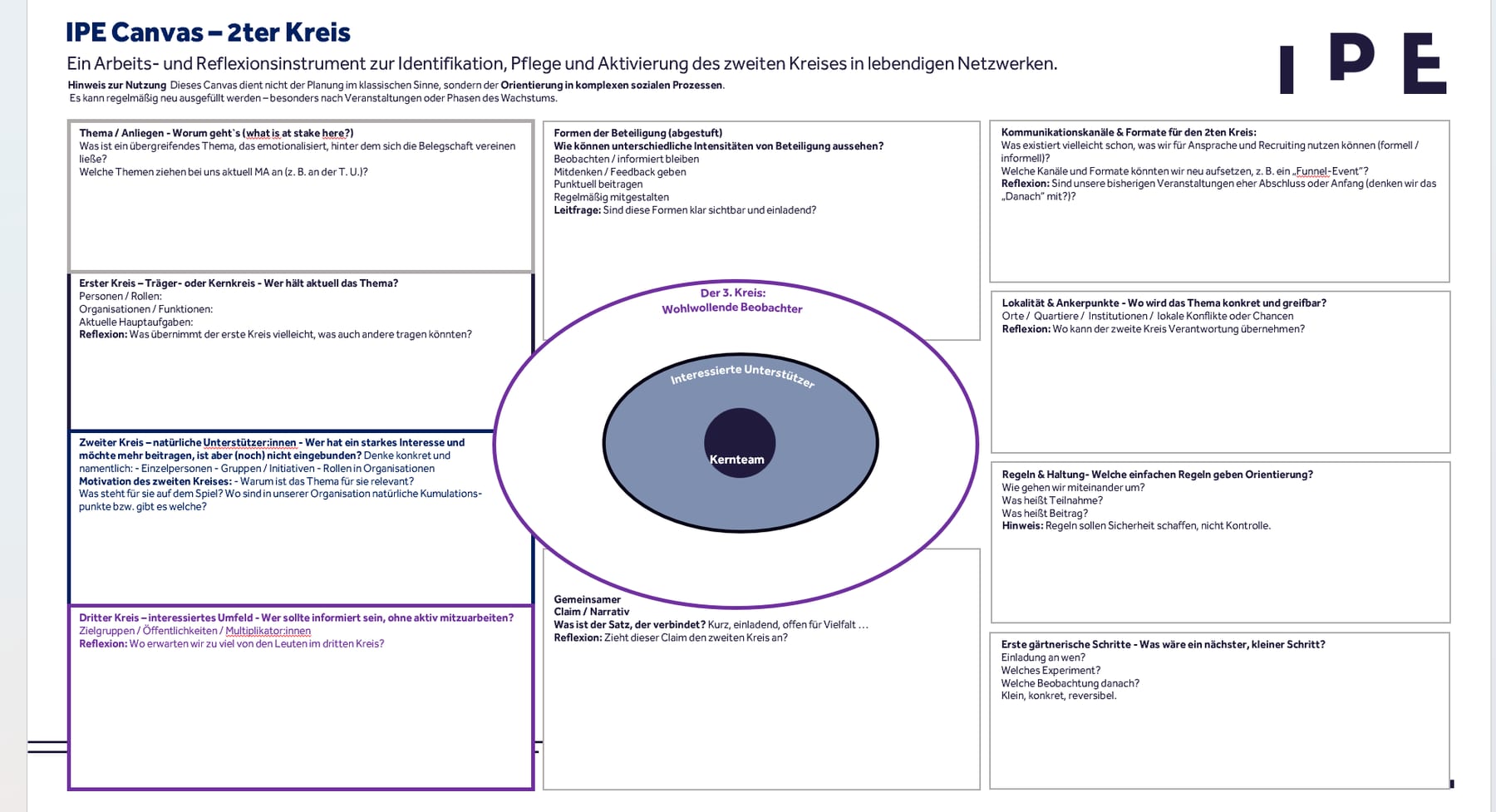
The Second Circle canvas is our tool for reflection and work – for identifying, nurturing and activating the second circle in living networks. It isn't classic planning, but orientation in complex social processes, and it gets filled in again and again, especially after events or phases of growth.
Build a second circle?
For organisations with a concrete undertaking: a short conversation about how a second circle can work in a given context.